
Review: Alt Choir by Westwood Instruments
Alt Choir is a highly emotive and enigmatic palette of beautiful human voices. This chamber sized choir is proudly contemporary and features fabulous performances of both experimental and more familiar articulations. It is hugely playable, with a detailed realism that is both inspiring and fun to compose with.
Jump to the Videos of Alt Choir by Westwood Instruments
Jump to the Demos of Alt Choir by Westwood Instruments
Review Alt Choir by Westwood Instruments
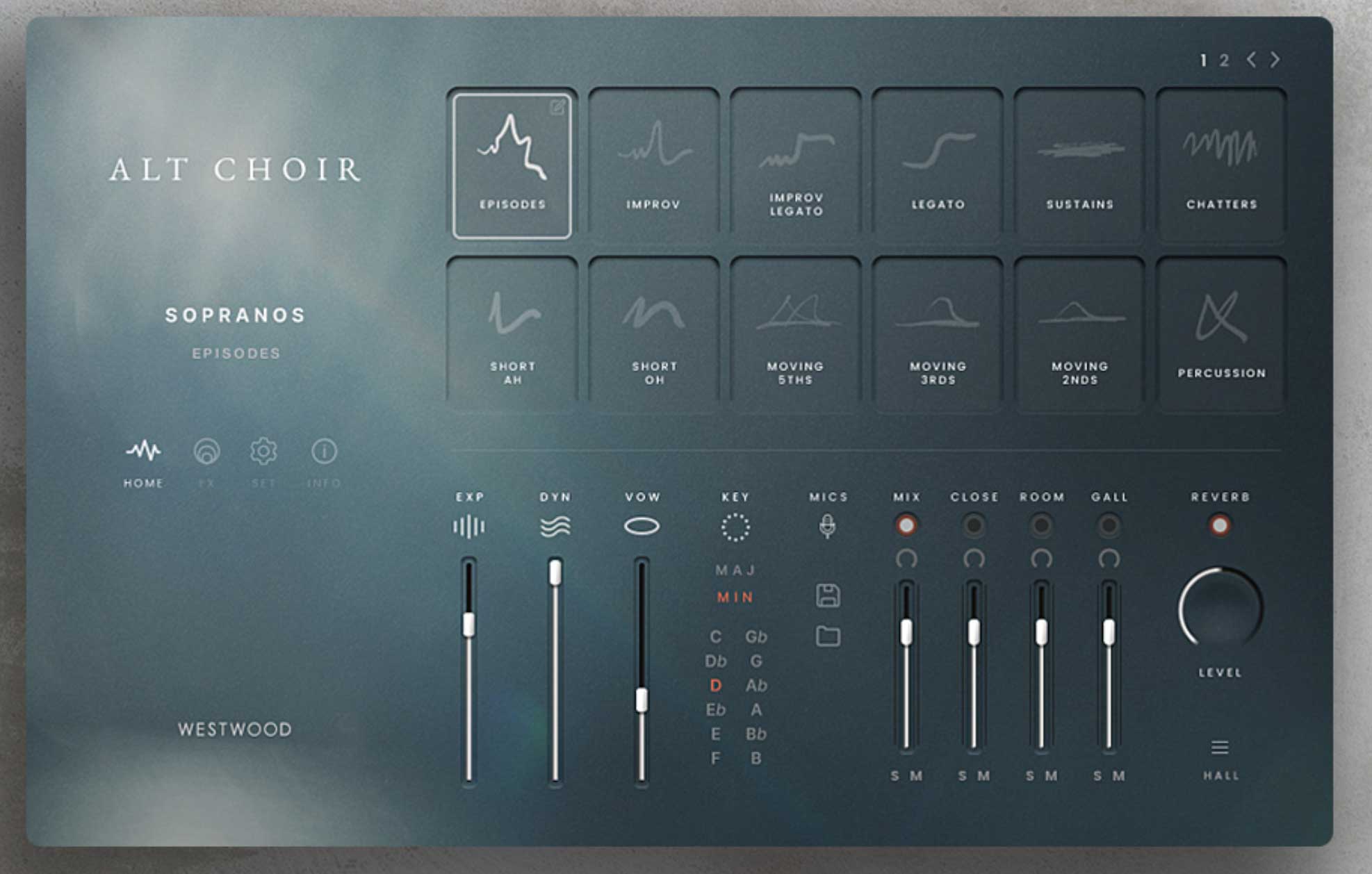
Westwood Instruments made their first foray into the human voice with last years Novella Origins library, which featured a small ensemble displaying a folky aesthetic as part of the overall package. Alt Choir seems inspired by the success of those recordings and builds on the idea with more singers (16 in total) separated out into individual sections. By using vocalists with backgrounds in folk, pop and indie, in addition to others more classically trained, the result is far less like your traditional choir. It’s certainly not epic, nor operatic and far more interesting and flexible for it. The articulations on offer are also less typical and more experimental. It is beautifully recorded with a simple three stereo mics set up at the developer’s preferred studio, The Nave. In addition to the choir samples we also have a Textures section, which mangles the source material into hybrid tones that feel half human, half machine. This is all wrapped up in the excellent Evergreen Framework Kontakt engine, built to be not just aesthetically pleasing, but also very intuitive for the end user.
Alt Choir normally sells for £239 from Westwood Instruments
Thoughts
The Ensemble patch, spanning three and a half octaves, is by far the best way to not only get an instant flavour of this library, but also to use as your broad brushstrokes compositional tool. The headline articulation, Episodes, displays the ethos of this library perfectly – human and detailed, with nothing overly polished, processed or perfect. This articulation is definitely alive with raw energy and you can often hear the individual singers. It is pretty hard to get anything to sound bad here, as long as one stays within the realm of the key signature that can easily be set on the interface. When using this articulation, the colours of the piano roll change to show that any green keys will play a melodic performance (scripted to stay in key), leaving the remaining blue keys to be normal sustains.
To call these remaining sustain keys normal would be something of an understatement though, as they are still deeply ingrained with improvisational waves of intensity, morphing timbres, and vibrato variances. The overall result is that shifting chord clusters will generally hold very well together with the odd chance that a green pitch changing note will be played along the way, adding an incredible sense of realism and surprise. Combined with some lush custom convolution reverb the naturally wide spread of the ensemble yields a beautiful wash of vocals. It is important to note that the available episodic keys (those that change pitch) on the Ensemble patch is far more sparse when compared to the separate sections. For instance, in the Ensemble the percentage of green keys to blue keys is around 15%, whereas in the individual sections the average is over 30%. This makes the sections more adventurous (note that Basses has no Episode patch).
The pitch changing notes are standardised in these patches to always be the root, third (minor or major), or fifth of whatever key signature you select. These samples last roughly 20 seconds in length and you can often hear lovely details like the breaths during the phrase, but unlike the blue keys do not loop. Watch out for that if you are using them to create mega long drones, as they will simply stop playing after a while. They can be shortened or lengthened by turning tempo sync on, which is surprisingly free from any noticeable time-stretching artifacts.
The Episodes could be described as pseudo phrase samples and this concept feels relatively on trend at the moment, somewhat mirroring the approach a few recent string libraries have taken. Some composers may bemoan this approach saying too much of the writing is done for you, but the melodies are slow and simple enough that it is really not aiming to create distinct vocal hooks – it is more of a melodic textural effect. They do all move pitch in time and at similar intervals though, so it can feel a little too neat if you play all green notes at the same time. It would have been interesting to have had an extra, more experimental, episodes gesture that was wilder in interval leaps and more random in the timing of them.
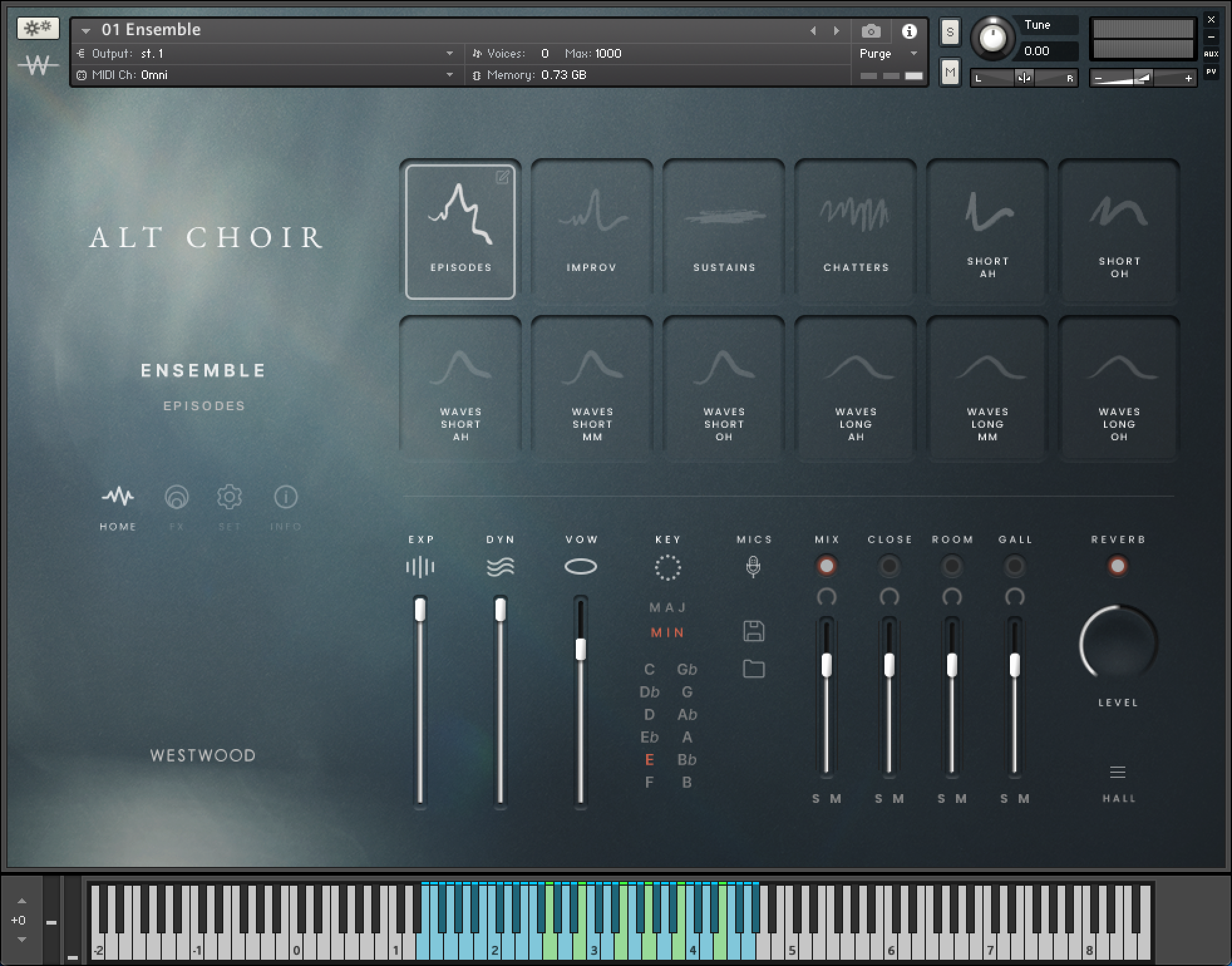
The natural theme continues as we move into the Improv articulation, which is essential the same as Episodes but without any melodic meanderings. It does, however, add a secondary layer of round robin action on each key. The way these performances develop with movement in the volume and vibrato intensity, plus subtle changes in pitch and timbre makes them very individualistic and when combined polyphonically it creates a highly complex and engaging sound. Like the Episodes there is a vowel control for even more variance, which very smoothly transitions from a predominantly ‘Ooo’ sound through a slight ‘Ehh’, to a more open ‘Aah’.
In comparison, Sustains sees things smoothed out considerably, yet we still have that wonderfully open and airy natural sound. It is worth noting at this point the power of the modulation. Dynamics (assignable to modwheel or velocity) utilises multiple layers from very gentle to assertive presence. There is nothing overblown here though, certainly no Handel’s Messiah! It is a limited range, but still very apparent, especially in the improvisational articulations, which are more restrained at lower dynamics than they are at full tilt.
The other standout articulations are the gorgeous legatos found in the individual sections. As these sections contain only four performers we can really appreciate that intimate sense of raw detail, but with enough voices to achieve some fullness. The movement between notes is notably more precise and quicker in the standard Legato patch compared to the Improv Legato. The latter has more mojo and edge to it, with a more pronounced vibrato being one of its defining factors. It can work very well for long pads – the samples are large and sometimes you will hear some surprising vibrato bursts four seconds later, worth the wait! By activating key switches and timing them well you can also get good results moving between both legato types, if for example you do want certain notes to be straighter. Legato transition length can be continuously varied to handle faster playing by using the speed knob.

Chatters is a quirky bubbling articulation with perhaps the widest dynamic range in the library. This is excellent for a more pointillistic, aleatoric feel and also works great layered with other articulations; I liked it lower in volume under the sustains to add some subtle movement. That one is common to all sections, but certain other articulations are not matched for some reason, possibly due to what sounded best for each vocal range.
The altos, tenors, and basses feature Breathy Sustains which is best described as having a fixed vowel sound of ‘err’. It is a sonorous, yet airy sound that is a really intelligent inclusion – this will get used a lot! The alto and tenor only Pitched Whispers is more particular, exhibiting an almost French ‘jeau’ vowel, and has a lot of whispy top end noise. The most subtle of all is the Soft MM articulation, which appears to be missing from the Sopranos. As its name suggests, this is a reliably gentle patch that just screams “feed me chords now!” With note transitions as smooth as this on a sustain patch I challenge anyone to play a VI-IV-I-V progression and not be inspired. All of these more experimental longs are typical of the Westwood aesthetic and work especially well as more nuanced layers within a composition that give just that hint of a human voice. In doing so they can really bring artificial sounding synth pads to life.
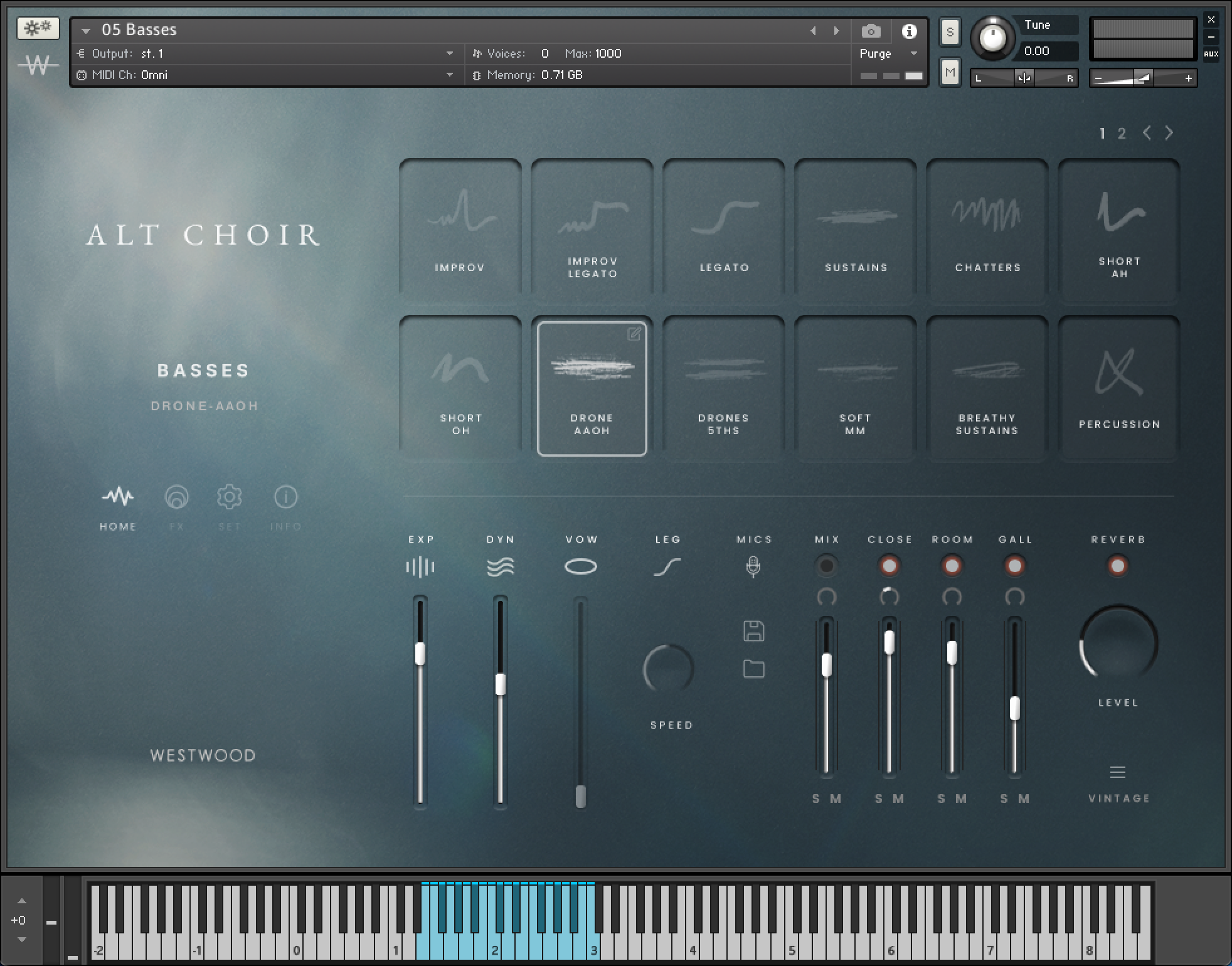
Westwood have given special attention to the Basses with some patches unique to this section. Drone AAOH has a baked in cyclical swell that moves from ‘aa’ to ‘oh’ ad infinitum, a la zen monk. The Drone 5ths are a great inclusion yielding interesting results that you may not normally come up with (octaves and perfect 4ths work wonders here).
Whilst the other three sections lack these drones, they make up for it with some brilliant articulations that include more predictable melodic motion, in comparison to the Episodes, in the form of three interval patches. Moving 5ths, 3rds and 2nds demonstrate how easy it is to create ethereal palettes of sound with some choice playing. Sometimes these intervals play at the same time (often in octaves) and other times they seem to oscillate; the interval may be consistent but there is still a good amount of variance in when one of the singers will make a leap. Minor or major thirds are triggered via soft or hard velocities, respectively. In theory, these moving intervals could have been a mess, but in practice they are stunning and really highlight the individual voices within each section. Note that the alto is short changed here and only features Moving 5ths.
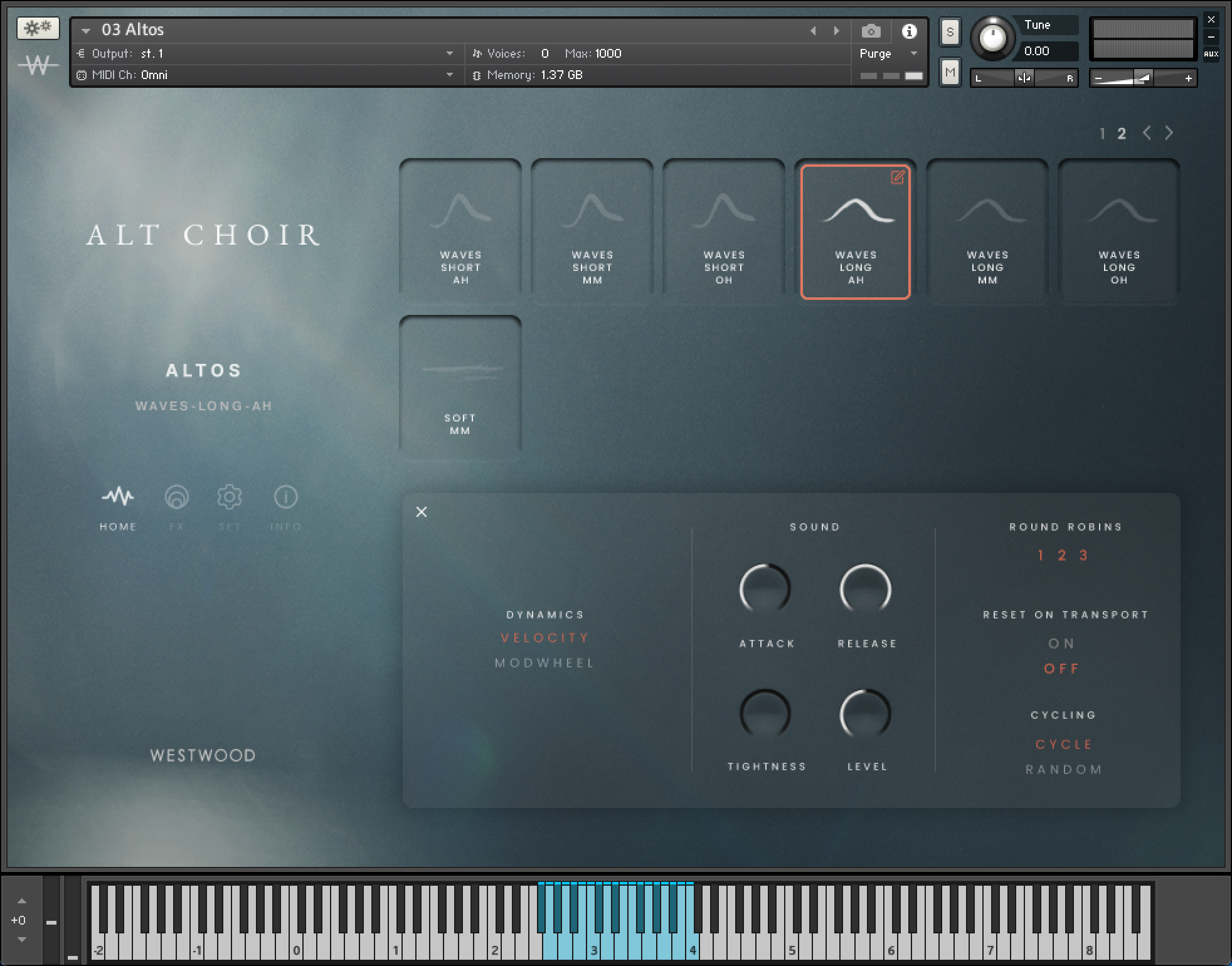
The Ensemble patch and each section also features Waves Short and Waves Long. Both lengths have three vowel options (Ah, Mm, Oh) and the quality of sound matches the already high bar set by the rest of the library. Each variation has three round robins, adding hugely to the realism. They are a bit quieter than the other articulations, even after changing from the default velocity control of dynamics to the modwheel. Waves Short don’t dynamically seem to change too much – it’s a relatively subtle swell, more like a cross between a wave and a long detached note. Under the hood we find it is the attack making the initial swell and not the actual recording which is a bit of a shame, though it may well have been to give the user more control over the wave shape. The Long Waves are better, revealing a good range of baked-in dynamics and with the attack available to further contour it. I kind of feel these could have been called medium as there is scope for even longer waves – articulations like this with real dynamics are so effective, so I am just greedy for more really!
By clicking the top right pencil icon in each articulation box we find controls for options such as Attack, Release, Tightness and Level. The release time is quite ample for a natural effect, but being able to unnaturally extend the release more here would allow for glorious cascading chords with smooth decay for ambient soundscapes – an option for an update maybe? We also have various Round Robin controls here, as well as options to assign dynamics to velocity or modwheel.
The envelope comes into its own when we turn our attention to the final set of articulations – the shorts. The reason here is that the Short Ah articulations sound ever so slightly unnatural. There is a hint of gunshot effect (despite the 5 round robins) but this can very easily be curtailed by using just a hair of attack to take off the edge. The Short Oh patches are universally excellent and more realism can be found overall by choosing the individual sections. Like all the articulations, shift clicking will layer them and in doing so we can get a composite vowel sound on the shorts and the illusion of a larger number of voices. Finally, we have the vocal Percussion one shots utilising seven round robins. These exhibit a range of stomps, claps, various sibilant consonants and other mouth noises, all of which are very interesting and perfect for spicing up percussion parts.
The four different mic options are superb and, surprisingly, all useable on their own, even the close mic. The Mix is a production ready curated choice that sounds fantastic out of the box. The Close gives a very tight stereo placement, which is handy for really pinpointing a section. It reveals the quite distinct panning of each section that when combined gives such a wide soundstage to the entire ensemble. Room is an XY stereo pair giving a wonderful all-round sound that feels the most balanced and natural. The Gallery stereo mics really reveal the wonderful space this was recorded in and adds ample depth. All of them have pan control, so you can push the soundstage wider, or even kind of reposition sections. I find it best to respect the recordings and make any panning fairly subtle, though it is effective to bring things central if only using a single section and requiring it to be less obviously focussed left or right. Westwood’s Reverb dial appears on the front page giving easy access to eight custom IR convolutions, covering a variety of spaces from a tight room to huge and ethereal. It is important to note that the reverb reflects the stereo placement of the particular section in use and what mics are in play. For instance, the reverb used with the soprano section will be biased towards the left side of the stereo field due to the position of the section. If there is also preponderance of Close Mic then that reverb will be even tighter in the left. Having a true stereo reverb like this ensures the wide semi-circular arrangement of the singers in the room is nicely preserved.
There is a concise FX page offering three broad brush EQ presets, stereo width control and a duplication of the reverb we see on each page. The deeply featured Replica delay is well presented with 24 presets to get you started that can be further adjusted with six dedicated dials. Transpitch has appeared on other Westwood libraries and shifts all the samples up whilst playing them slower so they stay on pitch – it’s a very simple way to morph the tonality for a different colour, albeit with a less realistic sound. With these FX included, the option to change the envelope per articulation, plus the ability to layer them, it is a bit of a shame there are no snapshots to showcase how radical the library can be. The settings page is where you can set preferences for things like keyswitches, purging and velocity sensitivity. Finally, we have an Info page with a full list of credits – I always think this is a nice touch to show appreciation for all involved.

Everything above would already make a stand out product, but Rob at Westwood was keen to push things even more and the result is Textures. This self contained patch is the result of taking the raw vocal recordings and going to town on the sound design front to create some amazing hybrid pads. They are generally on the gentle and atmospheric vibe to match the approach of the original choir. In each of the presets you can hear the vocal element, but it’s not the focus, instead just one part of the overall sound. The Textures span a variety of styles, from the low drone of Fog to the bright energy of Firefly. The samples are long and make great pads, more so if you employ a slow attack, but due to quite distinct starts each preset also makes very playable keys/leads. We get some basic ‘synth’ controls with LFOS for volume and pitch, a glide option and selectable playing mode (monophonic or polyphonic). The filter is weak though, only offering a low pass and with no modulation options. Although a relativity small part of Alt Choir and with only twelve presets, it is still a really worthwhile addition and has a classy hybrid tonality that can blend easily with other parts in a composition.

Alt Choir is another beauty from Westwood Instruments and offers a refreshing and inventive take on the human voice. I often struggle to incorporate choirs in more subtle underscore type cues as the typical bombastic epic choirs simply sound out of place, but Alt Choirs seems to solve this problem and I am eager to approach choirs quite differently now. Certainly, it has great appeal for songwriters and producers too, not just media composers. This is a unique indie choir full of exceptional performances presented in a wonderfully designed and easy to navigate interface. There are some innovative techniques explored which are very inspiring, but the library also has high quality bread and butter articulations should you need things a bit straighter. Above all, what I enjoyed most was how it presents a group of singers as an ensemble, but at the same time in an individualistic way too, with such detail and clarity on each single vocalist.
Facts
Alt Choir is a 20.9GB download via the Pulse downloader. It uses the free Kontakt Player version 6.6.1 or higher and is NKS compatible. There are 23 articulations, including 2 legato types, alongside 12 hybrid patches. It features up to 7 round robins, depending on the articulation. 3 mics are available, plus 1 pre-mixed blend.
Alt Choir normally sells for £239 from Westwood Instruments